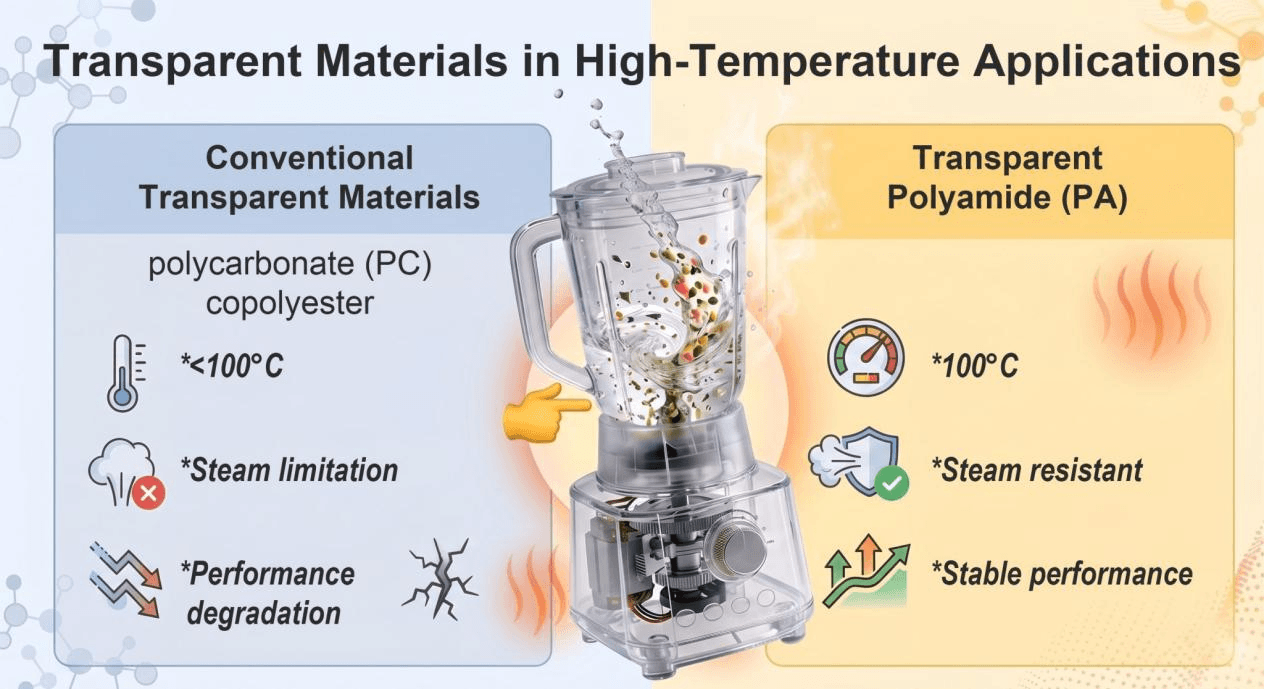
Transparent materials in kitchen appliances are typically limited to cold or low-temperature applications. The main constraint is not clarity—but performance under heat.
Enabling High-Temperature Blending with Transparent Polyamide (PA)
Transparent materials in kitchen appliances are typically limited to cold or low-temperature applications. The main constraint is not clarity—but performance under heat.
Materials such as polycarbonate (PC) and copolyester are widely used for their transparency, but their mechanical stability and long-term performance can degrade under boiling or repeated steam exposure.
Transparent polyamide (PA) addresses this limitation from a material design perspective.
By combining optical clarity with a semi-crystalline structure, it enables stable performance in applications where both heating and mechanical loading occur simultaneously.
From an engineering standpoint, this translates into:
Stable performance under boiling and steam conditions (>100°C);
High impact resistance maintained at elevated temperatures;
Structural integrity during repeated thermal cycling;
Transparency for real-time process visibility;
This makes transparent PA suitable for high-temperature food-processing applications such as thermal blenders and soybean milk makers, where materials are exposed to both heat and mechanical stress.
As appliance design evolves toward integrated “blend + cook” systems, the limiting factor is no longer functionality—but material capability.
What material limitations have you encountered in high-temperature transparent applications?