
Better Materials. A Safer Tomorrow.
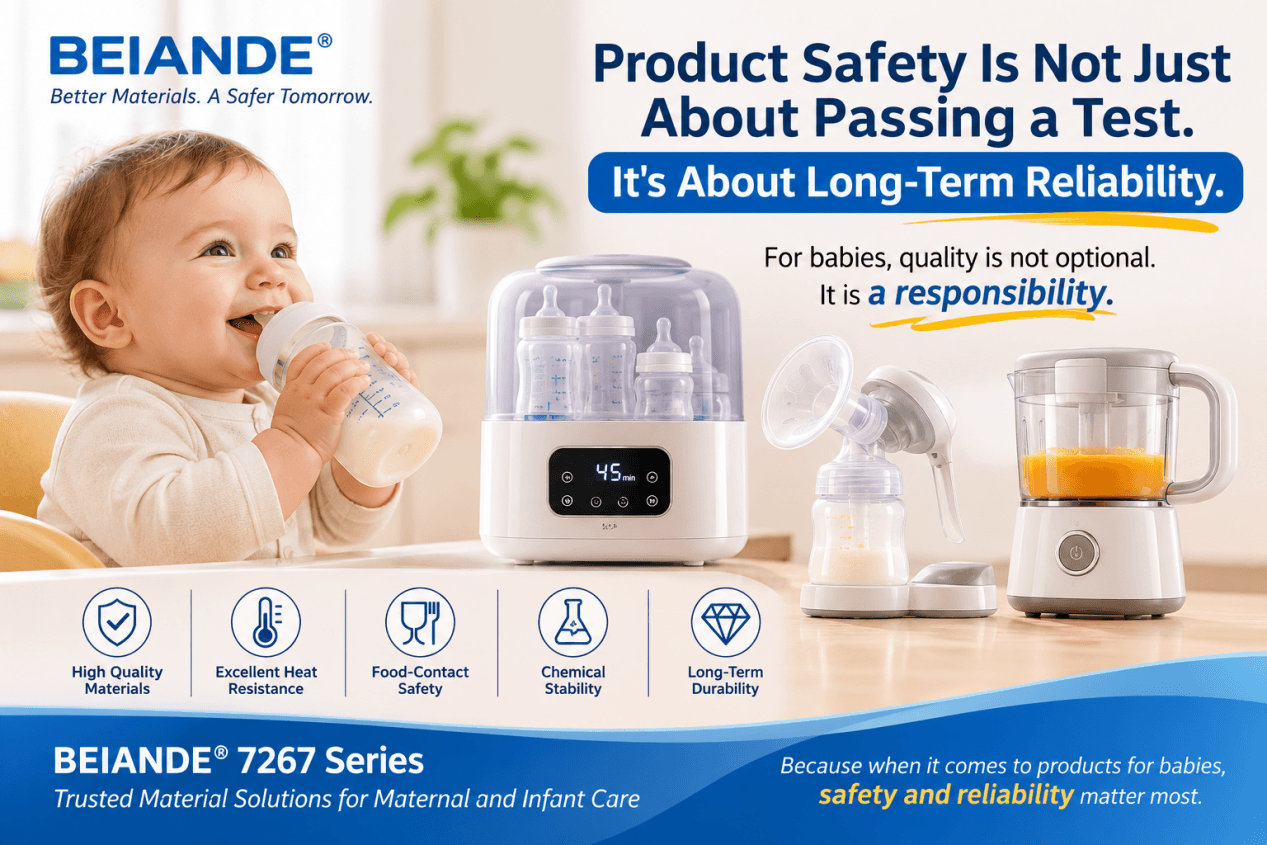
Last week, approximately 29,000 baby bottle sterilizer-dryers were recalled in the United States.
The issue wasn't chemical contamination, but rather the plastic housing overheating and melting. There were 32 reported incidents—with no injuries—and the company initiated a voluntary, well-handled recall.
However, this incident highlights a reality that the baby and infant product industry is often reluctant to address directly:
Problems with baby products rarely surface on the day they are brought home.
They tend to emerge 14 or 30 months later—after 800 steam cycles, 400 dishwasher runs, and countless cleanings with whatever household detergent happens to be at hand.
Consumers are beginning to ask different questions.
It’s no longer just about "BPA-free"—that’s merely the baseline requirement for entry.
Instead, they ask: Will the material remain the same three years from now? Will it yellow? Will the seams develop stress cracks? After prolonged exposure to high heat and humidity, will any substances migrate out of the material? And are the answers to these questions backed by empirical testing, or are they simply assumed?
This is a materials issue—one that is determined long before a product ever hits the shelf.
At BEIANDE®, our stance is straightforward: we produce materials backed by a comprehensive validation data package.
For our BEIANDE® 7267 series—designed for baby feeding products like bottles, breast pumps, baby food processors, and sterilizers—our validation process includes:
→ Long-term thermal aging tests, rather than a single spot-check at 100°C;
→ Re-evaluating mechanical property retention after repeated exposure to steam and detergents;
→ Migration testing conducted under real-world contact conditions, rather than selecting the most favorable (easiest) test parameters;
→ A focus on hygiene and cleanability, as surfaces that trap residue are prone to failure;
→ A clear, attractive appearance, allowing users to visually assess whether the product remains safe for continued use.
A standard technical data sheet might prove a material can perform once.
A fully validated process proves it can perform time and time again.
In this product category, there is no shortage of promises—what is often missing is the assurance that, three years down the line, there won't be any unexpected failures. If you are selecting materials for infant feeding or sterilization products, I would be happy to share our validation documentation—including the parts that most suppliers tend to leave out.